


Selling the Future: The Business of Predictions
There is a 26-year-old in Bengaluru paying Rs40 a minute to ask an astrologer whether her upcoming job interview is ‘in her stars.’ There is a hedge…
Published by Blue Mango Consulting Group | Research & Strategy Series
“Wherever there is uncertainty, there has always been a market for certainty. What changed is not the product — it is the infrastructure.”
There is a 26-year-old in Bengaluru paying Rs40 a minute to ask an astrologer whether her upcoming job interview is ‘in her stars.’ There is a hedge fund manager in Manhattan paying Kalshi a transaction fee to trade a contract on whether the Federal Reserve will cut rates in September. There is a superforecaster in London updating a probability model on Metaculus, predicting whether Ukraine will reclaim specific territory before year-end.
Three completely different people. Three completely different products. One identical business logic: sell structured certainty to people living in genuine uncertainty.
This is the Prediction Economy — and it is one of the most important, least understood sectors in global business today. It spans ancient Vedic astrology and cutting-edge financial derivatives. It encompasses a Rs1,214 crore Indian tech unicorn and a $22 billion CFTC-regulated US exchange. It includes a Noida founder who built India’s most efficient consumer business, a NASA-era superforecaster tradition, a sports betting empire worth over $110 billion, and Wall Street firms now integrating real-time prediction data into their trading terminals.
It is not one industry. It is a human need — the need for narrative, probability, and control in an uncertain world — expressed through dozens of different products across every income level, culture, and regulatory regime on earth.
This article maps the whole terrain.
The Architecture: Five Streams of the Prediction Economy
The prediction economy is not monolithic. It divides cleanly into five distinct streams — each with different customers, business models, regulatory exposure, and growth trajectories. Understanding the map is the prerequisite for understanding any individual opportunity within it.
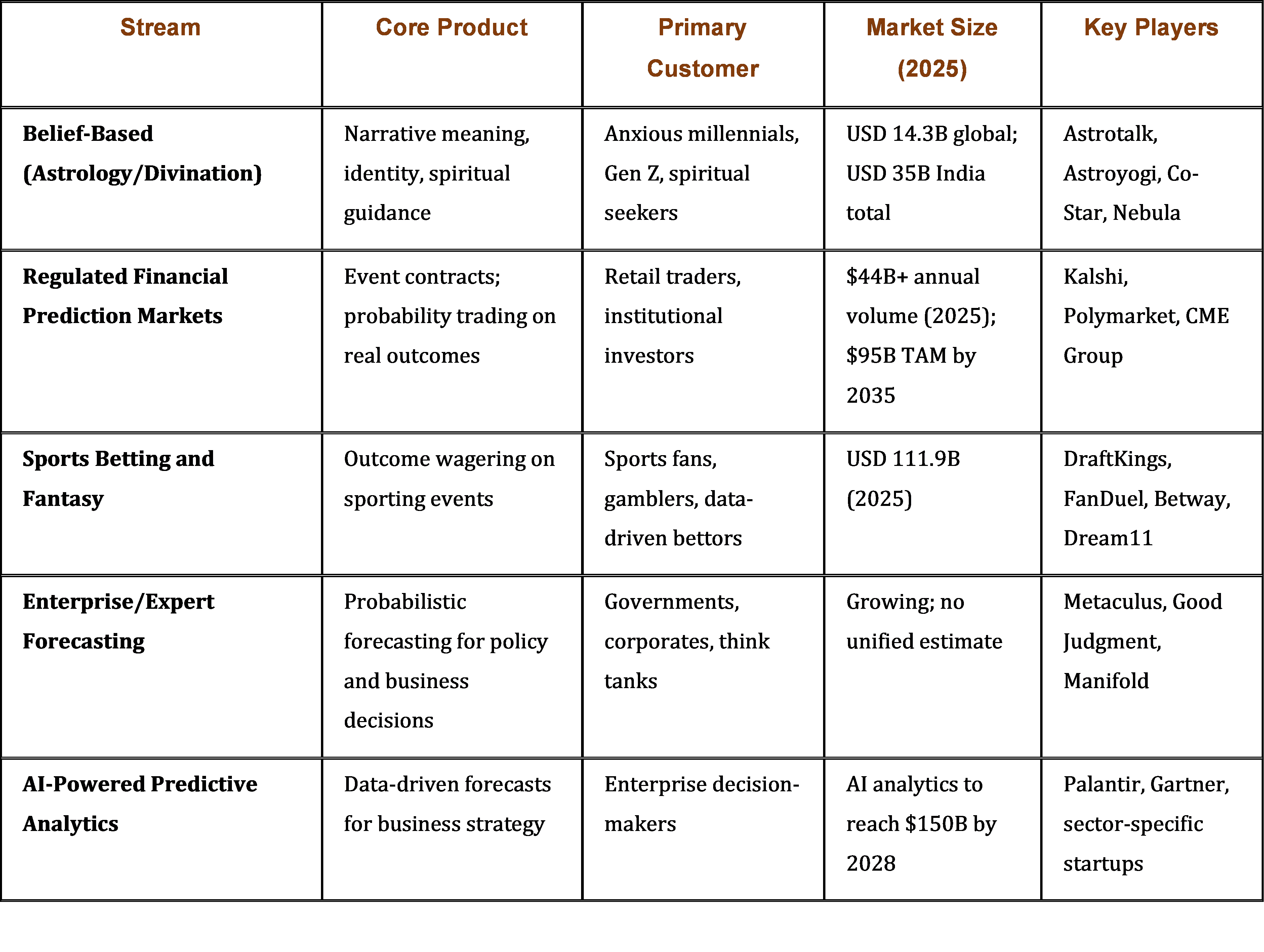
These five streams are converging. Kalshi and Polymarket are increasingly displacing sports betting. AI is disrupting expert forecasting. Astrology platforms are integrating AI. The next five years will see collisions, consolidation, and entirely new hybrid models emerging across all five.
Stream 1: The Ancient Business — Astrology, Divination & Spiritual Prediction Why People Buy It
Start with the oldest and still the largest stream. The prediction economy did not begin with a startup. It began with fear — the raw, primal fear of not knowing what tomorrow holds.
The Babylonians compiled the Enuma Anu Enlil around 1800 BC — 70 cuneiform tablets containing 7,000 celestial omens. In India, Vedic Jyotisha (the ‘eye of the Vedas’) became statecraft for kings and life-navigation for families, embedded so deeply that 78% of Indians still believe in astrology today. Every civilisation built its own version: Chinese astrology’s 12-year lunar cycle, Islamic celestial interpretation, Tibetan astrological medicine, Western Hellenistic sun-sign tradition.
The reason for that persistence is not irrationality. It is psychology.
The Barnum Effect (Forer, 1948) established that vague, positive, personalised statements are accepted as uniquely accurate by most people regardless of their actual source. Confirmation bias ensures customers remember hits and forget misses. Anxiety and institutional distrust — both at record levels in 2025 — make the demand structural, not cyclical.
The data is not soft:
· 80% of Gen Z and younger millennials believe in astrology · 65% of Gen Z users say astrology has reduced their anxiety · 39% of Gen Z men view it as an effective alternative to formal therapy · 30.1% of millennials have made a financial decision based on their horoscope The Business Numbers
The global astrology market is valued at USD 14.3 billion in 2024 and projected to reach USD 27.15 billion by 2035 (CAGR ~6%). The India astrology app market is growing at 49.19% CAGR, from USD 163 million in 2024 to a projected USD 1.8 billion by 2030. Only 1.5% of India’s estimated USD 35 billion total astrology economy is currently online — every percentage point of digital migration is USD 350 million in addressable revenue.
Astrotalk: The Benchmark
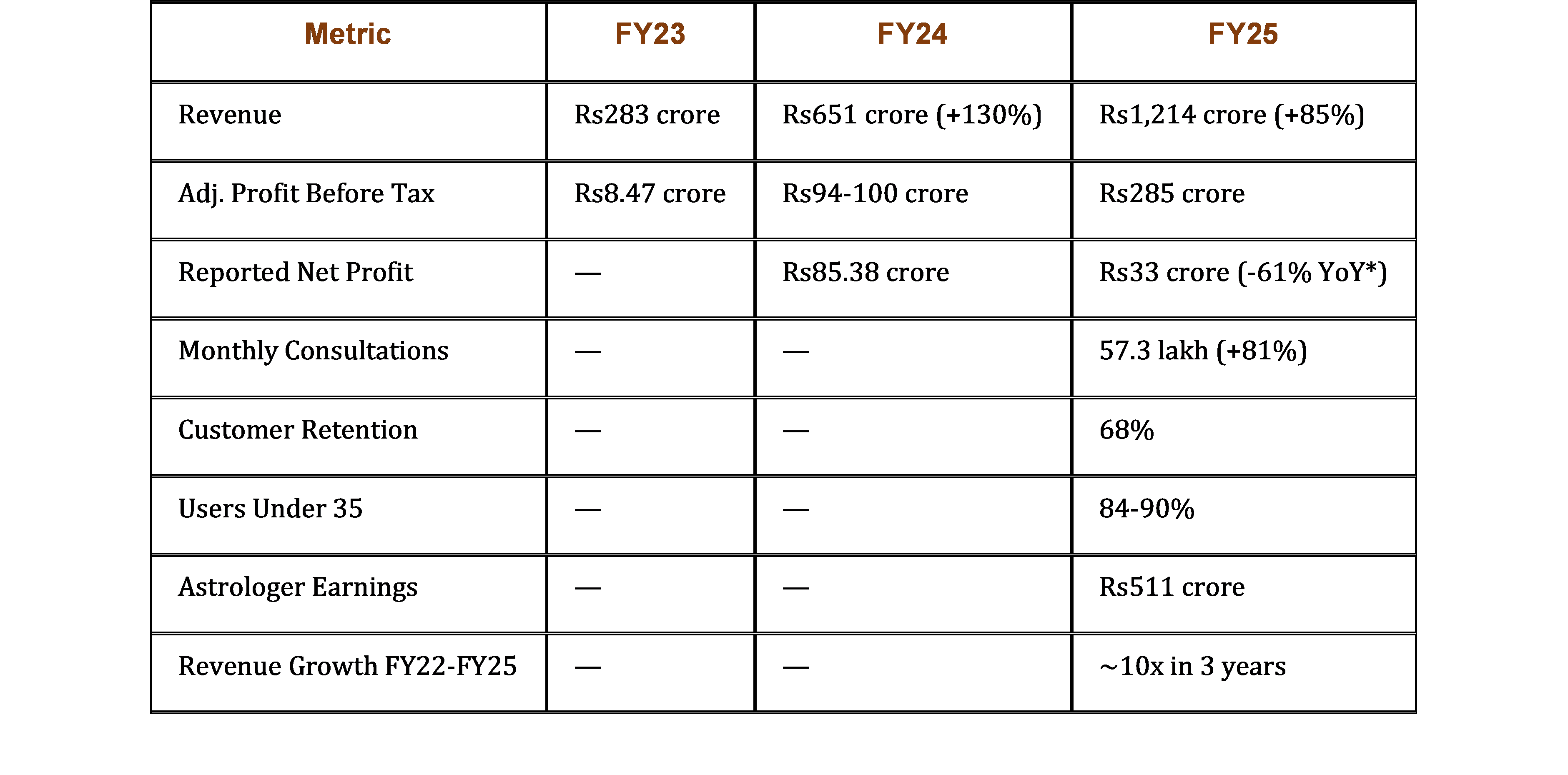
Net profit decline due to ~Rs120 crore non-cash ESOP costs and Rs80 crore IndAS mark-to-market adjustments; adj. PBT of Rs285 crore reflects underlying operating profitability.
Backed by Left Lane Capital and Elev8 Venture Partners, valued at Rs2,400 crore pre-money in June 2024, and actively exploring an IPO at a targeted $1.3-1.5 billion valuation in late 2026.
The Astrologer-Media-Politician Flywheel
The most powerful and least discussed distribution engine in the entire astrology business is a three-node alliance that scales reach at near-zero cost.
Astrologers gain mass visibility, credibility, and a paying client pipeline from every public political prediction. They don’t need to be accurate — a prediction vague enough will always have some element interpreted as fulfilled. A correct prediction is amplified; an incorrect one is buried under the next forecast. Political astrology is customer acquisition disguised as public commentary.
Media platforms — YouTube channels, news sites, social media — gain a highly efficient content product. A standard political video ages in 24 hours. An astrology-led political prediction creates three monetisable windows: pre-event anticipation, event-day reaction, and post-event ‘did it come true?’ analysis. One prediction triples the content surface area, algorithmically outperforming straight commentary at zero research cost.
Politicians gain cosmic validation — something ordinary communication cannot buy. When astrologers frame a leader’s rise as written in the stars, aligned with dharmic timing, or ordained by favourable planetary periods, electoral success becomes civilisational inevitability. Opposition is reframed as opposition to fate itself.
The flywheel in motion:
Bold political prediction made → Media packages as clickable headline → Audience returns pre/during/post event (3x content value) → Politician’s narrative benefits from cosmic legitimacy → Astrologer converts attention into consultations, remedy sales → Credibility grows → more media invitations → cycle repeats India’s top YouTube astrology channels — rival mainstream news audiences. The business model compounds: AdSense at high CPM from anxious audiences, sponsored integrations with gemstone brands and astrology apps, premium memberships, and offline event revenue.
The pattern is global, not uniquely Indian:
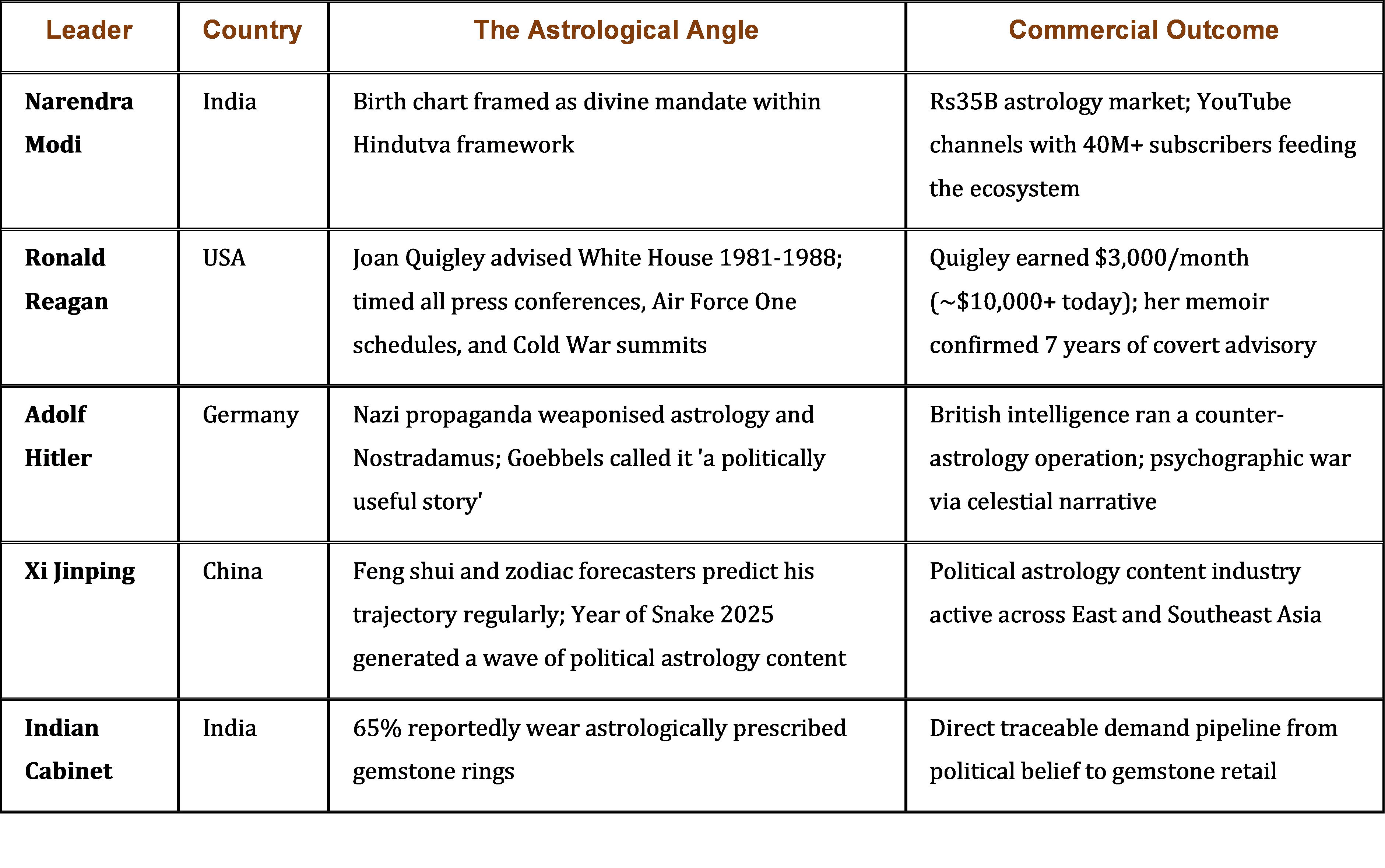
The unfalsifiability of astrological language — ‘Saturn’s influence on the 10th house indicates significant political authority, tempered by opposition forces’ — is not a weakness. It is the business moat. Every outcome confirms some element of every prediction. You cannot be wrong. You can only be early.
The 8 Revenue Streams of Spiritual Prediction 1. Per-minute consultation billing — Astrotalk earns Rs22,000/minute in revenue; Astroyogi starts at Rs9/minute 2. Subscription tiers — Co-Star (
$15M est. annual), Nebula ($516K single month Sept 2024), CHANI (~$405K monthly) 3. Prescription e-commerce — Astrotalk Store: Rs140+ crore Year 1; 60-80% margins on spiritually prescribed goods 4. Digital reports — Automated, zero marginal cost, Rs200-Rs2,000 per report 5. Education & certification — Rs3,000-Rs50,000 per course; trains the platform’s own future supply 6. Media monetisation — AdSense, sponsorships, premium memberships, offline events 7. Corporate wellness (B2B) — Emerging; one corporate contract worth 50x individual consultations 8. Affiliate commissions — 30-40% per customer acquired through content creator networks
Stream 2: Regulated Financial Prediction Markets — The Kalshi Revolution What Just Happened
The most explosive business story in the prediction economy over the past 18 months is not in India. It is in a CFTC-regulated exchange in the United States that most of the world is only now noticing.
Kalshi was founded in 2018 by Tarek Mansour and Luana Lopes Lara with a thesis that was simultaneously simple and radical: that human beings should be able to trade contracts on the outcome of real-world events the same way they trade stocks or commodities. Not gambling. Not speculation. Financial instruments.
They spent years navigating the CFTC before receiving federal regulatory approval — a structural advantage no competitor could easily replicate. Then, in September 2024, a key court ruling allowed Kalshi to offer election contracts. Volume exploded.
Kalshi’s trajectory:
· Aug 2025: $300M raise, $5B valuation · Dec 2025: $1B raise, $11B valuation (led by Paradigm; backed by Sequoia, a16z, Alphabet’s CapitalG) · Mar 2026: $1B raise, $22B valuation (led by Coatue Management) · $5B to $22B in seven months · Annualised revenue run rate: $1.5 billion · Annualised trading volume: $178 billion · Nearly $600M traded on a single day during March Madness 2026 · $1B+ traded on Super Bowl Sunday
Polymarket — Kalshi’s crypto-native rival — reached a $9B+ valuation with $22B+ in notional volume in the first 11 months of 2025 alone, up 57% from full-year 2024. Combined, Polymarket and Kalshi processed over $44 billion in cumulative trading volume in 2025, up from roughly $2 billion the prior year.
The broader prediction market industry total trading volume reached $63.5 billion in 2025, up from $15B in 2024 and $2B in 2023 — a 3,000% increase in two years.
Why This Is a Different Business from Astrology
Astrology sells meaning to people who want comfort. Prediction markets sell probability to people who want an edge. The customers are different. The business model is different. But the psychological root is identical: human beings cannot tolerate genuine uncertainty.
A Kalshi contract on ‘Will the Fed cut rates in September?’ is not a spiritual product. It is an information product priced by collective intelligence — and research from London Business School and Yale found that prediction markets correctly forecast 78% of corporate earnings outcomes, vs 62% for Wall Street analysts.
Piper Sandler estimates a $100 billion TAM for prediction markets within a decade. One analyst report projects annual revenue of $10 billion by 2030. The industry is projected to grow at 47% CAGR.
The New Entrants
The scale of Kalshi’s growth has forced every major financial platform to respond:

Robinhood’s CEO described the moment explicitly: ‘We’re at the cusp of a prediction market supercycle.’ The fastest-growing business line in Robinhood’s history reached $100M annualised revenue faster than any previous product — faster than crypto did in 2017.
Prediction Markets vs. Traditional Polling and Analysis
The commercial disruption potential goes beyond finance. Prediction markets are beginning to displace traditional polls, analyst forecasts, and expert commentary as the primary tool for pricing uncertainty across media, politics, and business:
· Prediction market prices replaced traditional polls as the primary real-time uncertainty metric during the 2024 US election · Monthly active users on prediction platforms grew from ~4,000 to 600,000+ between 2023 and 2025 · Polymarket introduced earnings markets in Sept 2025 (’Will BP beat quarterly earnings?’); accuracy at 78% vs 62% for Wall Street analysts · Economic indicator markets on Kalshi (CPI, unemployment, GDP, Fed rate decisions) generated over $1.1 billion in trading volume in 2024 · A January 2026 Federal Reserve working paper noted that Kalshi’s markets provide probability distributions of macro outcomes that traditional futures markets cannot replicate India: The Regulatory Collision
India is now the site of the most important prediction market regulatory battle in Asia. Platforms like Kalshi and Polymarket were gaining significant Indian user bases — particularly around IPL outcomes and election results — before the government moved.
In April 2026, India’s Ministry of Electronics and Information Technology (MeitY) sent notices flagging both platforms under the new Promotion and Regulation of Online Gaming Rules, 2026. The IT Secretary described enforcement as ‘a whack-a-mole situation’ as users continued accessing platforms via VPNs. SEBI issued a one-line advisory that opinion trading ‘does not fall within its regulatory purview’ — creating a regulatory orphan that India’s policymakers are now racing to address.
For entrepreneurs watching this space: India’s prediction market regulatory window is open but closing. The country that creates the legitimate, regulated, SEBI-adjacent equivalent of Kalshi for Indian markets — covering IPL, elections, RBI rate decisions, Sensex levels — will capture an enormous first-mover advantage.
Stream 3: Sports Betting — The Established Giant
Sports betting is the most mature, most regulated, and most commercially proven stream of the prediction economy. The global sports betting market was valued at USD 111.9 billion in 2025 and is projected to reach USD 226.2 billion by 2034 (CAGR 8.13%).
Sports betting is the prediction economy’s equivalent of the legacy newspaper — still vast, still profitable, but being structurally disrupted. The emergence of prediction markets (Kalshi’s March Madness volume nearly matched major sportsbook handles) and the entry of AI-powered prediction platforms is slowly reframing sports wagering not as gambling but as probabilistic information trading.
DraftKings and FanDuel, facing what industry analysts call an ‘existential threat’ from prediction markets, have both launched dedicated prediction market products. The integration of AI prediction engines — platforms like Billy Bets (Coinbase Ventures-backed), Sportstensor, and PredictBase — is adding a new AI-native layer to sports wagering that attracts a different customer profile: data-driven, analytically motivated, less casino-oriented.
The convergence thesis: within five years, the lines between sports betting, financial prediction markets, and AI-powered forecasting will blur into a single ‘probabilistic event trading’ product category.
Stream 4: Expert Forecasting — The Intellectual Infrastructure
The least commercial but arguably most important stream is the network of expert forecasting platforms building the intellectual infrastructure of the prediction economy.
Metaculus is an online forecasting platform with 2 million+ predictions across 17,000 questions. Metaculus users correctly predicted the date of Russia’s Ukraine invasion two weeks in advance and gave a 90% probability to Roe v. Wade being overturned almost two months before it happened.
Good Judgment Inc. — founded by Philip Tetlock, whose ‘Superforecasting’ research established the academic foundation for human probabilistic forecasting — provides forecasting services to governments and corporations, with ‘Superforecasters’ who have demonstrated track records of accuracy that significantly outperform expert baselines.
Manifold Markets uses play-money markets for ideation and crowd wisdom without financial stakes, attracting an EA and rationalist community of high-information forecasters.
Corporate internal prediction markets represent a largely untapped enterprise opportunity. Google ran internal prediction markets from 2005-2010 that improved forecasting accuracy by 25% reduction in mean squared error over expert forecasts alone. Microsoft used them to predict project milestones. Ford used them to forecast oil prices. The research is unambiguous: prediction markets improve organisational decision quality — yet most large corporations have not institutionalised them.
The emerging AI layer is now colliding with this expert tradition. In September 2025, British AI firm ManticAI ranked in the top 10 in the Metaculus forecasting cup, placing above numerous human experts. GPT-4.5 is now benchmarked as approaching superforecaster-level accuracy on short-horizon prediction tasks. AI models could match superforecaster accuracy within one year, according to benchmarks from Greg Brockman at OpenAI.
For business: the Gartner AI analytics market is projected to reach $150 billion by 2028, with forecasting applications accounting for 25% of that growth. The enterprise B2B forecasting-as-a-service opportunity is vast and largely unbuilt.
Stream 5: AI Predictive Analytics — The Business Infrastructure Layer
The fifth stream is not consumer-facing. It is the infrastructure layer being built beneath all the others.
AI-powered predictive analytics platforms are integrating with every industry that touches uncertainty: supply chain forecasting, demand prediction, customer churn modelling, credit risk scoring, insurance pricing, medical outcome prediction, climate risk assessment, and corporate earnings projection.
The global CLV and Churn Prediction AI market alone is projected to grow from $1.62 billion in 2025 to $10.74 billion by 2036 (CAGR 19%). The broader AI analytics market is projected to reach $150 billion by 2028.
Weather derivatives — financial contracts that pay out based on temperature, rainfall, or wind conditions — represent another significant intersection of AI prediction and financial markets. CME Group saw average trading volumes for its weather derivatives suite surge 260% in 2023. India’s NCDEX has launched its first parametric weather derivative product (RAINMUMBAI contract), hedging rainfall exposure in Mumbai.
The insight for strategists: every business that faces genuine uncertainty is a potential customer for the AI prediction infrastructure layer. This is not a niche. It is the business architecture of the next decade.
The Emerging Opportunity Map
Across all five streams, the same thesis holds: we are in the early innings of a fundamental shift in how human beings and institutions purchase, price, and act on predictions. The following opportunities are either nascent, underfunded, or entirely unbuilt:

What Unifies All Five Streams: The Psychology of Uncertainty
The most important insight across this entire landscape is that all five streams sell the same underlying product dressed in different clothes.
A Kalshi contract on the Fed rate decision and a Vedic astrology consultation about the right time to launch a business are structurally identical products. Both answer the question: ‘What is going to happen, and what should I do about it?’ One uses probability calculus and financial markets. The other uses planetary transits and birth charts. The customer’s psychological need — relief from the cognitive burden of genuine uncertainty — is identical.
This is not a trivial observation. It means that as prediction markets become more mainstream, they will increasingly compete with astrology, expert analysis, and traditional research for the same share of wallet and share of attention. Robinhood’s CEO calls it a supercycle. The prediction economy’s first wave — legitimised financial instruments — is only the beginning.
The deeper truth: in an era of fragmented institutional trust, algorithmic media, geopolitical volatility, and AI-driven disruption of traditional expertise, probability itself has become a product. The market for structured certainty is not a niche. It is a fundamental feature of the information economy.
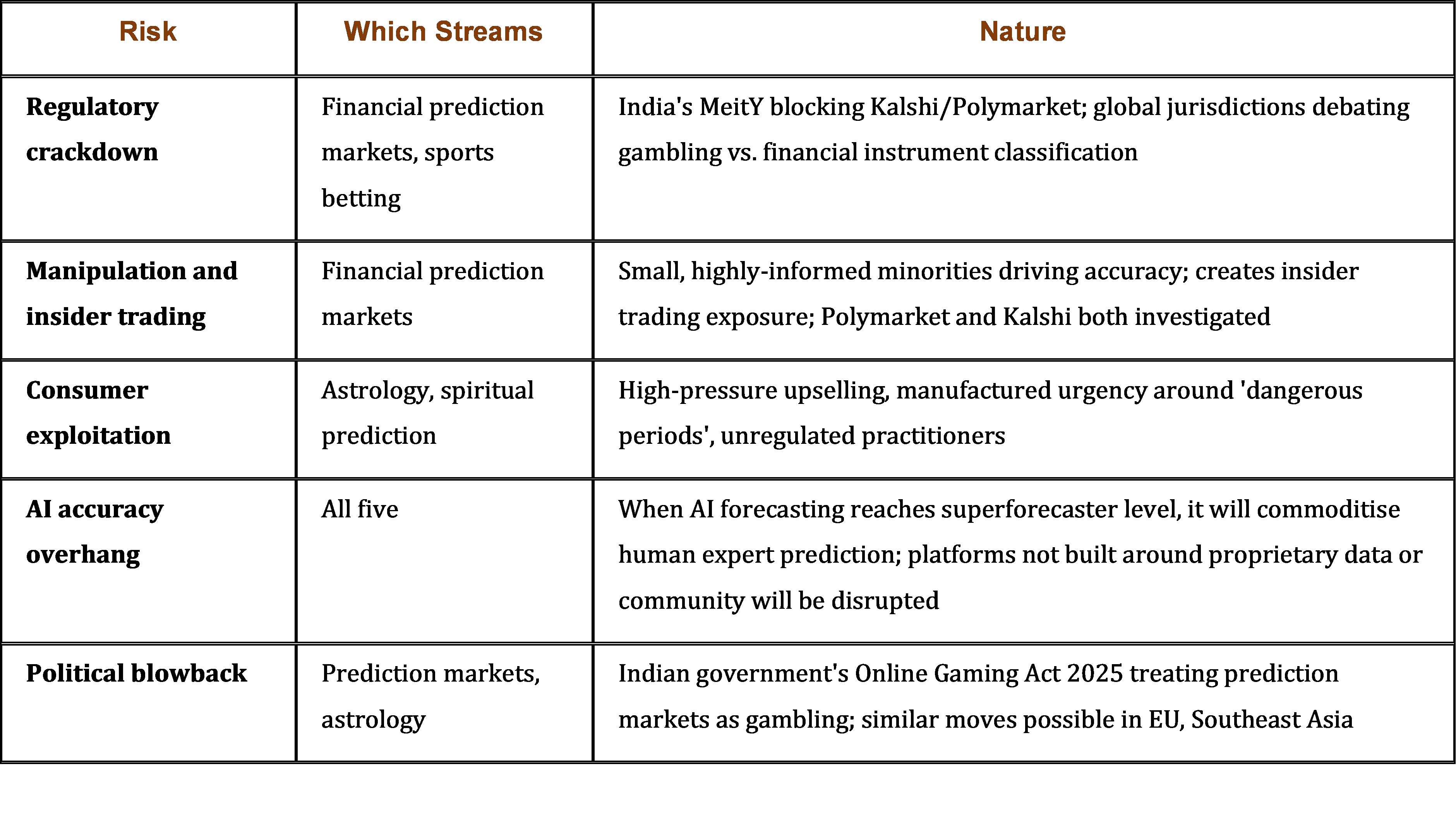
Risks Across the Prediction Economy
Closing: The Enduring Economics of Uncertainty
The Babylonian priests who read omens in clay tablets in 1800 BC and the engineers at Kalshi who built a CFTC-regulated exchange in 2026 are in the same business. They are both answering the same human question: ‘What happens next?’
The product is not the clay tablet or the trading contract. The product is the relief of not not-knowing.
What changed is the infrastructure — and the infrastructure changes everything. From a Rs9-per-minute astrology consultation to a $22 billion prediction exchange. From a daily horoscope app to Robinhood’s fastest-growing product line. From a political astrologer advising the Reagan White House to AI models approaching superforecaster accuracy on Metaculus.
The five streams of the prediction economy are not five separate industries. They are five different interfaces for the same ancient human trade. And the trade — selling certainty to people living in uncertainty — has no foreseeable saturation point.
Wherever there is fear, there is a business in comfort. Wherever there is uncertainty, there is a market for certainty.
The prediction economy is one of the few sectors in global business where that has been true for 4,000 years — and where the next decade looks more promising than any that came before it.
About This Article
This piece is part of Blue Mango Consulting Group’s Research & Strategy Series on emerging consumer economies, behavioural business models, and India’s digital sector transitions.
DISCLAIMER This article is published for educational, research, and strategic business analysis purposes only . The views expressed are analytical observations of market dynamics and do not constitute an endorsement of astrology, prediction markets, sports betting, occult practices, or any prediction-based product or service as suitable for investment, personal decision-making, or financial planning. All market data, financial figures, valuations, and statistical claims are sourced from publicly available research reports, news publications, financial filings, regulatory documents, and industry databases referenced throughout the text. Market valuations and financial projections are subject to change; readers should independently verify all figures before use in any commercial, investment, or strategic context. Financial and investment disclaimer: Nothing in this article constitutes financial advice, investment advice, or a recommendation to buy, sell, or trade any security, commodity, prediction market contract, or other financial instrument. Prediction markets, sports betting, and similar products carry significant financial risk. Past performance — including prediction accuracy and platform revenue — does not guarantee future results. Regulatory disclaimer: The regulatory status of prediction markets, sports betting, online gaming, and astrology services varies significantly by jurisdiction. What is legally permitted in the United States under CFTC regulation may be prohibited in India, the European Union, or other markets. Readers operating in any jurisdiction should obtain independent legal advice before engaging with any platform or product discussed in this article. The mention of specific companies, platforms, products, or individuals is purely for illustrative and analytical purposes and does not constitute a commercial recommendation, endorsement, or criticism of any entity. The discussion of political narratives, religious frameworks, and cultural practices is presented in a factual, analytical context. No religious, cultural, or political community is being disparaged. References to scientific research reflect the current scientific consensus where applicable. The description of astrology’s psychological mechanisms does not constitute an endorsement of its predictive validity, which science has not established. (c) 2026 Blue Mango Consulting Group. All rights reserved. This content may be shared with full attribution. It may not be reproduced for commercial purposes without written permission.
Blue Mango Consulting Group | Substack Research Series
First published on Substack.